
Most buyers understand that a higher interest rate means a higher monthly payment. What fewer buyers fully appreciate is the second consequence: a higher rate doesn’t just cost you more each month, it shrinks the purchase price you can afford in the first place. In Denver’s market, where the median home sits at $600,000, the difference between a 6% rate and a 7% rate isn’t just a number on a payment stub. It’s the difference between affording the home you actually want and making uncomfortable compromises. Understanding this math before you start shopping changes everything about how you approach your search.
The Math Most Buyers Don’t Run Until It’s Too Late
Lenders qualify you based on your ability to make a monthly payment, not based on a purchase price. That means your approved purchase price moves up and down with every change in rate, sometimes dramatically.
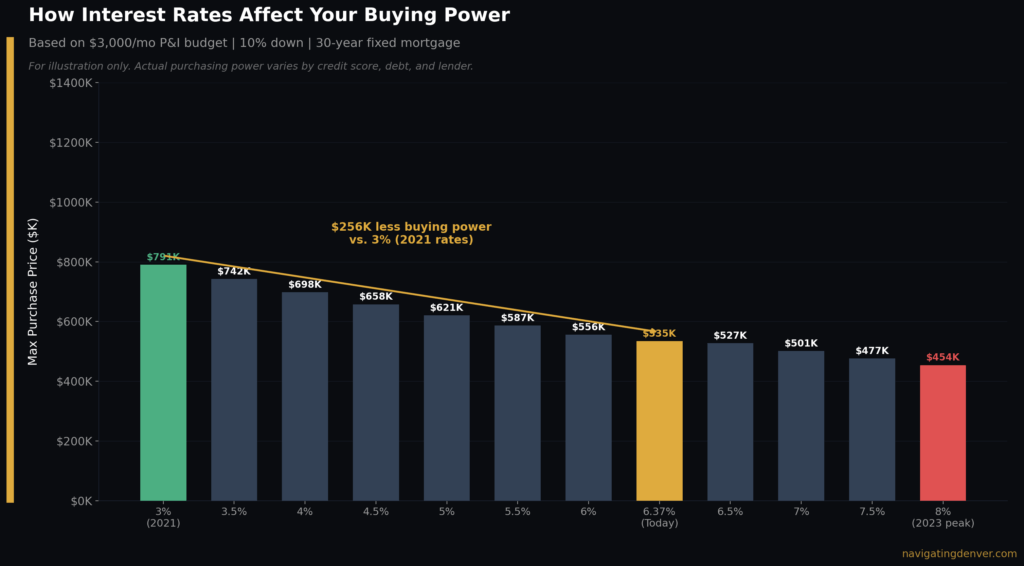
Here is a concrete example using a $3,000 per month principal and interest budget, a realistic ceiling for many Denver buyers, and 10% down:
| Rate | Max Purchase Price | Monthly P&I |
|---|---|---|
| 3.0% (2021) | $800,000+ | $3,000 |
| 5.0% | ~$645,000 | $3,000 |
| 6.0% | ~$570,000 | $3,000 |
| 6.37% (May 2026) | ~$535,000 | $3,000 |
| 7.0% | ~$490,000 | $3,000 |
| 8.0% (2023 peak) | ~$445,000 | $3,000 |
At 3%, the rate environment that defined 2021, a $3,000 monthly budget bought over $800,000 in purchase price. At today’s 6.37%, that same budget gets you to roughly $535,000. That is a difference of more than $265,000 in purchasing power, wiped out entirely by the rate environment with no change in income, savings, or financial profile.
This is not abstract. It means buyers who were looking at one tier of Denver neighborhoods in 2021 are now looking at a completely different tier in 2026. The market didn’t price them out, the rate environment did.
What Different Rates Actually Cost at Denver Price Points
Rather than working backward from a budget, let’s look forward from price, because most buyers start with a home they want, then figure out whether they can afford it.
Here is the monthly principal and interest payment on three common Denver price points across a range of rates, all assuming 10% down:
$450,000 Home ($405,000 loan)
| Rate | Monthly P&I | vs. 6.37% |
|---|---|---|
| 5.5% | $2,299 | -$204 |
| 6.0% | $2,430 | -$73 |
| 6.37% | $2,503 | — |
| 6.75% | $2,627 | +$124 |
| 7.5% | $2,832 | +$329 |
$600,000 Home ($540,000 loan)
| Rate | Monthly P&I | vs. 6.37% |
|---|---|---|
| 5.5% | $3,066 | -$272 |
| 6.0% | $3,239 | -$99 |
| 6.37% | $3,338 | — |
| 6.75% | $3,503 | +$165 |
| 7.5% | $3,776 | +$438 |
$750,000 Home ($675,000 loan)
| Rate | Monthly P&I | vs. 6.37% |
|---|---|---|
| 5.5% | $3,833 | -$340 |
| 6.0% | $4,049 | -$124 |
| 6.37% | $4,173 | — |
| 6.75% | $4,379 | +$206 |
| 7.5% | $4,721 | +$548 |
The pattern is clear: every half-point rate increase costs roughly $150 to $550 per month depending on price point. Over a 30-year loan, a half-point difference on a $600,000 purchase amounts to more than $59,000 in additional interest. That is not a rounding error.
Pro Tip: Before you set your price range, ask your lender to model two or three rate scenarios. A rate that moves from 6.37% to 6.75% between your pre-approval and your closing date can eliminate $30,000 to $50,000 of purchase price you thought you had. Rate locks exist for this reason, use them.

The Hidden Cost of Waiting for Rates to Drop
It is tempting to look at today’s 6.37% rate and decide to wait, hold off until rates come back down to 5% or lower and then buy. On the surface that strategy makes sense. In practice it carries significant risk that rarely gets discussed.
Home prices don’t pause while you wait. Denver’s median price has held steady at $600,000 heading into spring 2026. If prices appreciate even 3% annually while you wait for rates to drop from 6.37% to 5.5%, a $600,000 home becomes an $618,000 home. Your monthly payment calculation now starts from a higher base, potentially erasing much or all of the savings from the lower rate.
Rates may not drop as far as you expect. The current consensus from MBA and Fannie Mae points to the 30-year fixed staying in the low-to-mid 6% range through the end of 2026. A meaningful drop below 6% is possible but not guaranteed, and every month you wait is a month of rent paid with no equity accumulation.
You can refinance. You cannot buy yesterday’s price. The standard advice in real estate is “marry the house, date the rate” — and it exists for a reason. If rates drop after you close, you have the option to refinance. If home prices appreciate while you wait, you cannot go back and buy at the lower price.
When Refinancing Makes Sense: A Detailed Breakdown
Refinancing replaces your existing mortgage with a new loan, typically at a lower rate, which reduces your monthly payment and the total interest paid over the life of the loan. But refinancing isn’t free, and whether it makes financial sense depends entirely on three variables: how much your rate drops, what the closing costs are, and how long you plan to stay in the home.
What does refinancing actually cost?
Refinancing closing costs typically run between 2% and 3% of the loan amount for a full refinance, though some lenders offer “no-closing-cost” options that roll those costs into the new rate. On a $540,000 loan (10% down on a $600,000 home), typical refinance closing costs fall in this range:
| Cost Item | Estimated Range |
|---|---|
| Origination / lender fee | $1,000 – $2,500 |
| Appraisal | $500 – $800 |
| Title insurance and settlement | $1,200 – $2,000 |
| Recording fees and misc. | $200 – $500 |
| Total estimated | $3,000 – $6,000 |
The break-even point, when monthly savings from the lower rate exceed the cost of refinancing, is the number every homeowner needs to calculate before they pull the trigger.
The Break-Even Analysis: Is the Refinance Worth It?
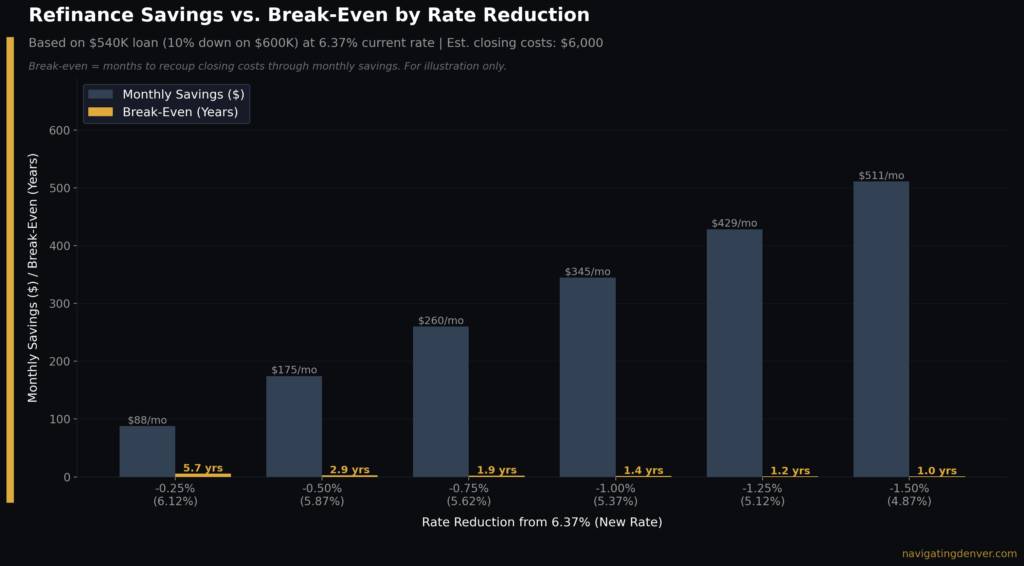
Using a $540,000 loan at a current rate of 6.37% and estimated closing costs of $6,000, here is exactly what different rate drops would mean for monthly savings, total interest saved, and how quickly the refinance pays for itself:
| Rate Drop | New Rate | New Payment | Monthly Savings | Break-Even | 5-Yr Net Savings | 10-Yr Net Savings |
|---|---|---|---|---|---|---|
| -0.25% | 6.12% | $3,278 | $60/mo | ~8.3 yrs | -$2,400 | -$800 |
| -0.50% | 5.87% | $3,196 | $142/mo | ~3.5 yrs | +$2,520 | +$11,040 |
| -0.75% | 5.62% | $3,117 | $221/mo | ~2.3 yrs | +$7,260 | +$20,520 |
| -1.00% | 5.37% | $3,039 | $299/mo | ~1.7 yrs | +$11,940 | +$29,880 |
| -1.25% | 5.12% | $2,963 | $375/mo | ~1.3 yrs | +$16,500 | +$38,940 |
| -1.50% | 4.87% | $2,888 | $450/mo | ~1.1 yrs | +$20,980 | +$47,980 |
Based on $540K loan balance, $6,000 closing costs, 30-year fixed. Assumes no cash-out and no term extension. Net savings figures are after recouping closing costs.
A few things jump out from this table.
A quarter-point drop does almost nothing useful. At -0.25%, your monthly savings of $60 take over eight years to recoup your $6,000 closing cost. Unless you have a compelling reason, like dramatically improved credit or getting out of an ARM, a quarter-point refinance rarely pencils out.
A half-point drop starts to make sense with a 3.5-year break-even. If you plan to stay in the home for five or more years, a half-point refinance on a Denver-area loan produces real, measurable savings.
A full point drop is where refinancing becomes genuinely compelling. At -1.00%, you are saving nearly $300 per month, breaking even in under two years, and generating close to $30,000 in net savings over ten years. If rates drop a full point from today’s 6.37% to 5.37%, most current Denver buyers should strongly consider refinancing.
No-Closing-Cost Refinances and Other Options
If paying $6,000 in closing costs upfront isn’t feasible, lenders often offer a no-closing-cost refinance, where the costs are either rolled into the loan balance or absorbed in exchange for a slightly higher rate. This can make sense when:
- Your savings timeline is uncertain (you may move within a few years)
- You don’t have liquid cash for closing costs
- The rate improvement is modest and the math only works with no upfront cost
The trade-off: a no-cost refi at a rate 0.125% to 0.25% higher than the true market rate means your monthly savings are smaller, and your long-term savings are reduced. Run both scenarios with your lender before deciding.
A note on ARMs and refinancing: Buyers who took Adjustable-Rate Mortgages in recent years may face a different calculation as their fixed period ends. If your ARM is adjusting into a higher rate than the current fixed market, refinancing into a 30-year fixed is often worth serious consideration regardless of the exact rate differential.
Rate Strategy: What to Do and What to Avoid
✅ Do This
- Get pre-approved before you tour homes — know your exact budget at today’s rate
- Ask your lender to model rate scenarios so you understand your price range cushion
- Use a rate lock once you are under contract — rates can move between contract and closing
- After closing, set a mental trigger: “If rates drop one full point, I will call my lender”
- When refinancing, run the break-even calculation before you sign anything
❌ Avoid This
- Waiting indefinitely for rates to return to 3% — that environment required a global pandemic and emergency Fed intervention
- Assuming a no-closing-cost refinance is automatically better — it trades upfront savings for long-term cost
- Refinancing multiple times in a short window without running the cumulative break-even math
- Ignoring the home price appreciation variable when calculating the true cost of waiting
The Bottom Line on Rates, Buying Power, and Refinancing
Interest rates are the single most powerful variable in the home affordability equation, more impactful than most buyers realize until they run the actual numbers. In Denver’s market, the difference between a 6% and 7% rate isn’t cosmetic. It’s $80,000 to $100,000 of purchase price at a typical budget.
The good news is that today’s rate environment, while elevated compared to 2021, is meaningfully better than the peak of 2023 — and the path to refinancing is available if rates continue to improve. Buyers who close at 6.37% today and refinance if rates drop to 5.37% will end up in a strong financial position over a ten-year horizon, particularly if Denver home values continue their long-run appreciation trend.
The worst financial decision in this market is paralysis: waiting for conditions to be perfect, running out the clock on rent payments, and watching home prices gradually move away from a rate environment that eventually does improve. Buy when you are financially ready, at the right home, at a realistic price — and let refinancing take care of the rest if the opportunity presents itself.
If you want to run these numbers against your specific income, down payment, and target price range, that is a conversation worth having before you make any decisions. Reach out and we will work through it together.
Payment estimates calculated using standard amortization formula. Closing cost estimates based on Denver metro market averages and may vary by lender, loan size, and transaction. All rate figures current as of May 2026. This post is for informational purposes and does not constitute financial or lending advice. Consult a licensed mortgage professional for guidance specific to your situation.
Have Questions About This Topic?
Every situation is different. Let’s talk about how this applies to your specific goals in the Denver market. No pressure, no obligation — just straight answers.