
Spring in Denver has delivered what the market needed most: consistency. The April 2026 data — the freshest numbers available as we head into May — shows a metro that is holding steady on price, moving faster than it was this time last year, and generating more buyer activity than the headline inventory numbers might suggest. This isn’t a market in distress, and it isn’t a market running hot the way 2021 was. It’s a market that rewards preparation on both sides of the transaction. Here’s what the numbers actually say.

The Headline Numbers: April 2026 Denver Metro
The Denver metro housing market maintained steady performance in April, with key indicators pointing toward a stable and balanced landscape for both buyers and sellers. Here’s the full snapshot:
| Metric | April 2026 | Year-Over-Year |
|---|---|---|
| Median Home Price | $600,000 | Flat (0% change) |
| Closed Listings | 4,018 homes | Flat YoY |
| Median Days in MLS | 15 days | Up 1 day YoY |
| New Listings | 6,642 | Down 6% YoY |
| Pending Listings | 4,326 | Up 8% YoY |
| Active Inventory | Down ~9% | ~12 weeks supply |
| 30-Year Fixed Rate | ~6.37% | Down from 6.76% a year ago |
The headline that matters most here isn’t the price — it’s the combination of rising pending activity and falling inventory. Despite a 6% year-over-year decline in new listings, pending activity grew 8%, meaning buyers are absorbing available homes faster than new supply is coming in. That is not a market softening — that is a market tightening from the inside.
The Market Is Moving Faster Than It Looks
The metro-wide median of 15 days on market is the number that should get buyers’ attention. Month over month, median Days in MLS dropped by three days to 15, indicating homes are selling more quickly as demand strengthens heading into the spring season.
Fifteen days is not leisurely. For buyers who believe they have unlimited time to deliberate on a well-priced home, this data is a reality check. The homes that check the right boxes — condition, location, price — are not sitting. They are moving in two weeks or less.
For sellers, the same number tells a different story. Active listings decreased 9% overall, with approximately 12 weeks of inventory available, suggesting conditions remain competitive and emphasizing the need for strong pricing and positioning strategies. The market will reward correctly-priced, well-presented homes. It will not bail out overpriced ones — 12 weeks of supply is enough that buyers have options and will move on.

Mortgage Rates: Better Than a Year Ago, Still Elevated
The 30-year fixed-rate mortgage averaged 6.37% as of May 7, 2026, up slightly from the prior week but meaningfully lower than the 6.76% average recorded a year ago at this time. That roughly 40-basis-point improvement over twelve months translates to real money on a Denver-area purchase.
On a $600,000 home with 10% down, a rate of 6.37% versus 6.76% means approximately $155 less per month — or nearly $1,900 per year. Compounded over the life of a 30-year loan, that difference is substantial. Buyers who delayed a year ago waiting for rates to fall further may find the 2026 window more favorable than they expected.
Mortgage rates are expected to stay in the low-to-mid 6% range over the next 90 days, with no dramatic swings anticipated unless major economic shifts occur. The consensus view from MBA and Fannie Mae points toward gradual easing through the back half of 2026 — though nothing is guaranteed, and waiting for a specific rate to materialize has historically cost buyers more in appreciation than they save in interest.
| Home Price | Down (10%) | Loan Amount | Est. P&I at 6.37% |
|---|---|---|---|
| $450,000 | $45,000 | $405,000 | ~$2,530/mo |
| $550,000 | $55,000 | $495,000 | ~$3,090/mo |
| $600,000 | $60,000 | $540,000 | ~$3,372/mo |
| $700,000 | $70,000 | $630,000 | ~$3,933/mo |
P&I only. Add property taxes, insurance, HOA, and PMI if applicable

How the Key Submarkets Are Performing
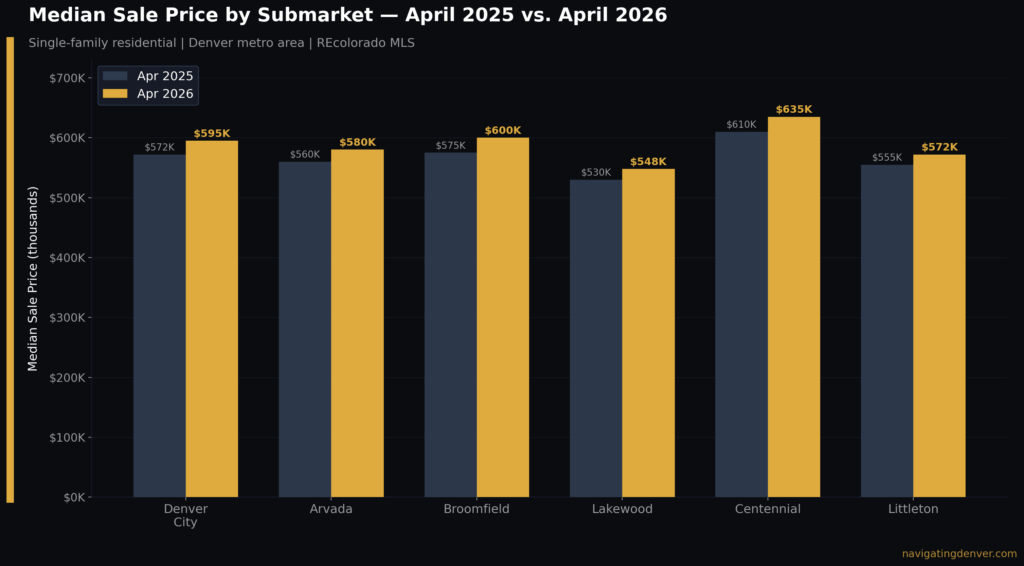
The metro median tells the story at 30,000 feet. Here’s what’s happening at ground level across the six submarkets in this series:
Denver City — In March 2026, Denver home prices were up 5.0% compared to last year, with a median price of $595,000. The condo segment continues to carry more inventory and longer days on market than single-family. Buyers looking for urban value are finding it in attached housing right now.
Arvada — Consistently one of the most active suburban markets in the metro. The Old Town corridor continues to drive demand, and homes priced correctly in the $500K–$600K range are seeing competitive activity. Days on market running below the metro average.
Broomfield — Holding steady at the metro median. The north suburban corridor is attracting buyers priced out of Boulder County who want proximity without the premium. New construction activity is adding supply at the upper end.
Lakewood — The best value play closest to the mountains continues to attract outdoor-lifestyle buyers. The west side is performing above the metro average on pace; buyers are active and decisive in this submarket.
Centennial — The Cherry Creek Schools premium is intact. Well-priced homes in established Centennial neighborhoods are still seeing multiple-offer scenarios at the right price point. Sellers here have more leverage than the metro average suggests.
Littleton — Balanced and active. Historic downtown Littleton and C-470 access continue to make this submarket a consistent performer. Days on market are running at or slightly below the metro median.
Pro Tip: The 8% jump in pending listings metro-wide is the most underreported number in this month’s data. Pending contracts are a leading indicator — they tell you where closed sales will be in 30 to 45 days. If you’re a buyer who thinks the market is slow and negotiations are easy across the board, this number should recalibrate your expectations heading into the summer.
A Note on the Rental Market
In the Denver metro rental market, median rent declined 5% year over year to $2,695, while rental properties took slightly longer to lease, with median Days in MLS increasing by three days to 23. For renters watching the market, softening rents and slower leasing pace give them negotiating leverage they haven’t had in several years. For would-be buyers on the fence between renting and purchasing, the rent-versus-buy math is shifting — lower rents reduce the urgency to buy, but stabilizing home prices and improving mortgage rates are tightening the long-term financial case for ownership.
What This Market Means for You Right Now
If you’re a buyer:
- Get pre-approved before you start seriously touring — 15 days median means the right home doesn’t wait
- The 8% pending increase signals rising competition heading into summer; spring momentum is real
- Rates at 6.37% are down meaningfully from a year ago — the window is more favorable than the headlines suggest
- Use submarket-level data to guide your search; Lakewood and Arvada are outperforming the metro on pace
If you’re a seller:
- Correct pricing from day one remains non-negotiable; the 12-week inventory level gives buyers options
- Closed listings increased 9% month over month and median home prices rose 2%, reflecting ongoing price stability with slight upward pressure heading into the peak spring season — momentum is on your side if you enter correctly
- Presentation matters: staging, photography, and competitive list price are the three levers sellers control

The Bottom Line for May 2026
The Denver metro is performing exactly as a healthy, balanced market should: prices stable, activity rising, inventory tightening, and rates improving year-over-year. The buyers who move thoughtfully and decisively are finding success. The sellers who price correctly and present well are still getting strong results without the chaos of the pandemic years.
June’s report will tell us whether the spring momentum carried through — but the leading indicators in this month’s data point in a positive direction. If you want to know what these numbers mean specifically for your neighborhood, your price range, or your timeline, that conversation is worth having before summer gets here.
Data sourced from REcolorado MLS Market Watch Report (May 6, 2026), Freddie Mac Primary Mortgage Market Survey (May 7, 2026), and Zillow. Metro figures reflect greater Denver area residential sales through April 2026. Submarket estimates based on available MLS data. Individual results vary by property type, location, and condition.
Have Questions About This Topic?
Every situation is different. Let’s talk about how this applies to your specific goals in the Denver market. No pressure, no obligation — just straight answers.