
The Denver metro market is showing its summer character. May data is now out from REcolorado, and the numbers tell a clear story: prices are rising, supply is tightening, and buyer demand remains steady even as the market settles into its typical summer rhythm. This is not a market that is cooling. It is a market that is consolidating — with sellers gaining a little more leverage than they had in April, and buyers needing to be more strategic about how they approach what’s available. Here is everything you need to know heading into mid-summer.
The Headline Numbers: May 2026 Denver Metro
May produced one of the cleaner data months we have seen in a while — prices ticking up, pace holding steady, and a notable contraction in new supply. Here is the full snapshot:
| Metric | May 2026 | Year-Over-Year |
|---|---|---|
| Median Home Price | $615,000 | Up 3% |
| Closed Listings | 4,054 homes | Down 2% |
| Median Days in MLS | 16 days | Up 2 days |
| New Listings | 6,002 | Down 18% |
| Pending Listings | Up 4% MoM | Steady demand |
| Active Inventory | ~12 weeks supply | Tighter than April |
| 30-Year Fixed Rate | 6.47% | Down from 6.81% YoY |
The number that should jump out is new listings down 18% year over year. That is a significant contraction in supply. Even with closed listings down only 2% — meaning buyer demand is essentially unchanged — the inventory side of the equation got noticeably tighter through May.
When demand stays steady and new supply drops 18%, prices respond. That is exactly what May showed: the metro median climbed to $615,000, up 3% from May 2025. This is not runaway appreciation — but it is meaningful, sustained pricing strength.
Pace Is Holding — Buyers Are Being Selective
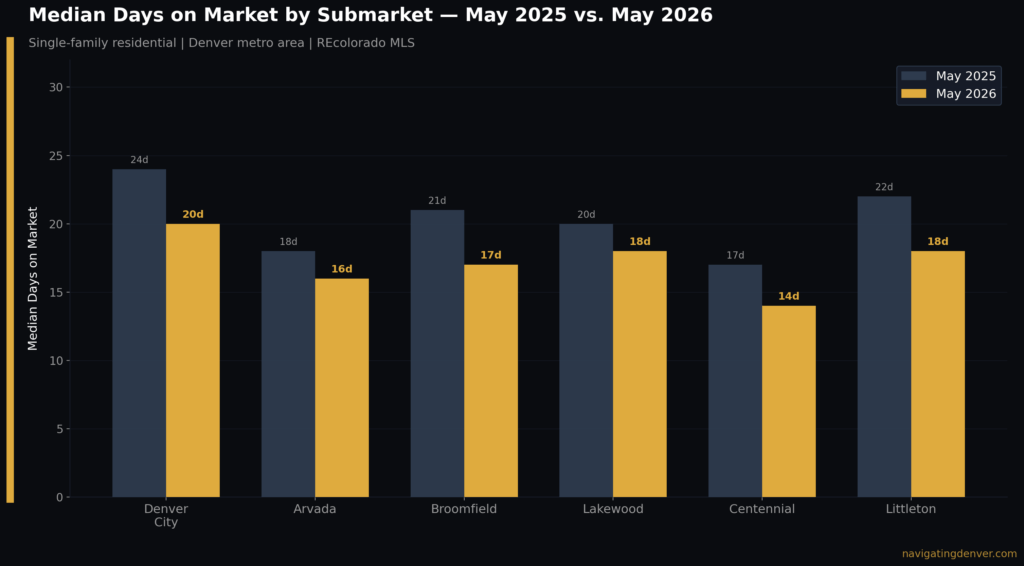
Median days in MLS came in at 16 days for May — one day higher than April’s 15, and two days higher than May 2025. That is a very modest slowdown, and it tells a specific story: buyers are taking slightly more time to evaluate, but the well-priced homes are still moving in two to three weeks.
A 16-day median is not the market slowing down in any meaningful sense. It is the market behaving like a healthy spring-into-summer market should — measured, deliberate, but still active. Buyers are paying attention to value. They are looking past overpriced listings and moving on the ones that are correctly priced from day one.
For sellers, that 18% drop in new listings is genuinely good news. Less competition in your specific price band means well-positioned homes are getting more attention than they would have in a more crowded inventory environment. The risk has not disappeared — overpriced homes are still sitting — but the headwind is lighter.
Mortgage Rates: Range-Bound, But Better Than a Year Ago
The 30-year fixed-rate mortgage averaged 6.47% as of June 18, 2026, down slightly from 6.52% the prior week and meaningfully below the 6.81% average from one year ago. Rates have been oscillating in a relatively narrow band between roughly 6.4% and 6.6% since February — neither dropping dramatically nor spiking.
Two factors are keeping rates range-bound: persistent inflation concerns, and geopolitical tensions in the Middle East that have pushed up oil prices and bond yields. Until one of those variables resolves clearly, expect rates to continue trading in this mid-6% zone.
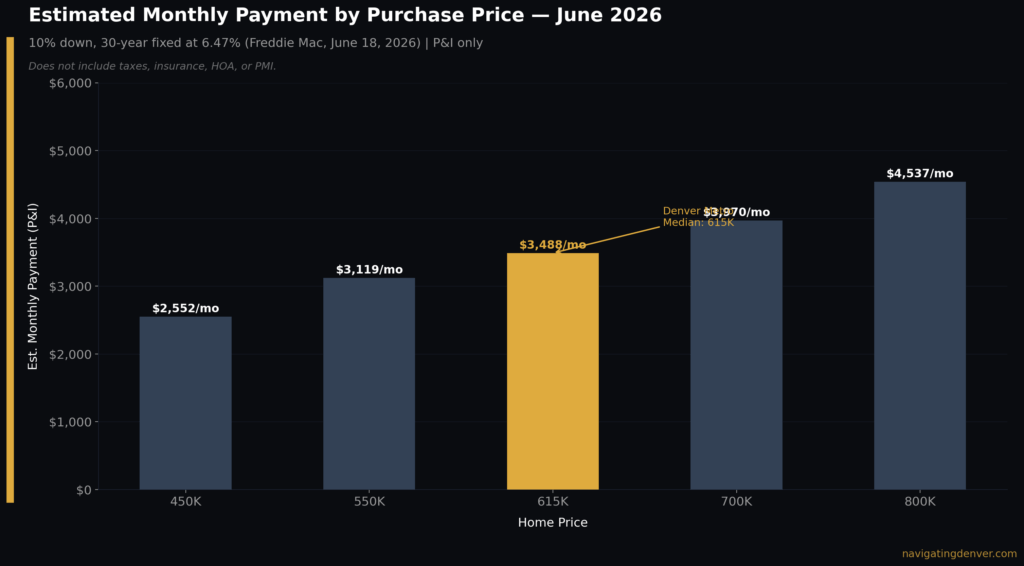
For buyers, the practical takeaway is that today’s rate environment is roughly 34 basis points better than a year ago. On a $615,000 home with 10% down, that translates to approximately $130 per month in savings compared to early summer 2025 — real money, even if it isn’t a dramatic shift.
| Home Price | Down (10%) | Loan Amount | Est. P&I at 6.47% |
|---|---|---|---|
| $450,000 | $45,000 | $405,000 | ~$2,553/mo |
| $550,000 | $55,000 | $495,000 | ~$3,120/mo |
| $615,000 | $61,500 | $553,500 | ~$3,488/mo |
| $700,000 | $70,000 | $630,000 | ~$3,971/mo |
P&I only. Add property taxes, insurance, HOA, and PMI if applicable.
How the Key Submarkets Are Performing
Here is what’s happening at the submarket level across the six communities in this monthly series:
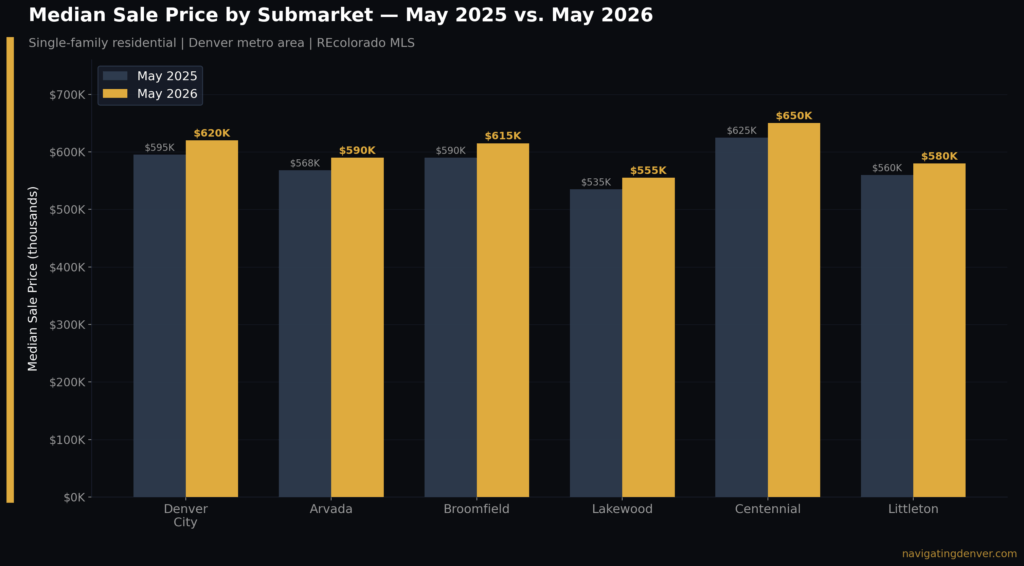
Denver City — The urban core is around $620K median and trending up. Single-family demand remains the strongest segment; condos continue to carry longer marketing times. Buyers looking for urban value should be focused on attached housing where negotiation room still exists.
Arvada — Around $590K and consistently active. Old Town Arvada continues to drive demand for buyers who want a walkable historic core. Well-priced homes in the $500K–$650K range are seeing strong activity, with days on market running below the metro average.
Broomfield — Tracking at $615K, right at the metro median. The location advantage between Denver and Boulder, combined with the extensive open space network, continues to attract buyers priced out of Boulder County proper.
Lakewood — Around $555K and still offering the best value play closest to the mountains. Outdoor lifestyle buyers remain a steady source of demand, particularly on the west side near Bear Creek and Green Mountain.
Centennial — At $650K, the Cherry Creek Schools premium remains intact and arguably strengthening. Days on market at 14 — the fastest pace among the six submarkets. Sellers here have meaningful leverage if priced correctly.
Littleton — Around $580K, balanced and active. Historic downtown Littleton, Chatfield access, and Littleton Public Schools continue to deliver steady performance.
Pro Tip: The 18% drop in new listings is the most underreported number in this month’s data — and it has direct consequences for buyers. Fewer new homes coming to market means the inventory you see this week is closer to the full inventory available. If a home meets your criteria, move on it. The market is not refilling supply the way it was earlier in the spring.
A Note on the Rental Market
The Denver metro rental market continues to soften relative to a year ago. Median rents are down year over year, and properties are taking slightly longer to lease as renter demand stays steady but supply expands at the multifamily level — Denver has officially overbuilt at the apartment level after years of record-setting construction. For current renters, this gives genuine negotiating leverage on lease renewals. For would-be buyers, the rent-versus-buy calculation has shifted modestly: softer rents reduce monthly pressure to buy, but rising home values continue to widen the long-term wealth gap between owning and renting.
What This Market Means for You Right Now
If you’re a buyer:
- Inventory is contracting — the 18% new listing drop means fewer homes will come to market this summer than last
- Get pre-approved before touring; 16 days median means the right home does not wait
- Rates at 6.47% are roughly 34 basis points better than this time last year — the math has improved
- Watch Centennial and Arvada for the most competitive activity; Lakewood and Littleton for the best value plays
If you’re a seller:
- Pricing strength is real — a 3% YoY increase in median price means the market supports correct pricing
- Less competition from new listings means well-presented homes are getting more attention
- Pace has slowed slightly to 16 days median, but that is still healthy; the homes sitting are the overpriced ones, not the well-positioned ones
- Summer momentum favors sellers who enter with a sharp price and strong presentation
The Bottom Line for June 2026
The Denver metro is heading into summer with a clear directional signal: prices up, supply down, rates manageable, and demand steady. This is a healthy market that rewards preparation. Sellers who enter with realistic pricing and strong presentation are getting strong outcomes. Buyers who get pre-approved and move decisively on the right homes are finding success.
The story to watch through July is whether the new listing contraction continues. If June and July show similar 15–20% YoY declines in new supply, expect continued upward pressure on prices through the back half of the summer. If new listings rebound, the market settles into a more balanced rhythm.
If you want to know what these numbers mean specifically for your neighborhood, your price range, or your timeline, that conversation is worth having now. The summer market moves fast — and the buyers and sellers who prepare in June tend to have the best outcomes in July and August.
Data sourced from REcolorado MLS Market Watch Report (June 2026), Freddie Mac Primary Mortgage Market Survey (June 18, 2026), and Colorado Association of REALTORS. Metro figures reflect greater Denver area residential sales through May 2026. Submarket estimates based on available MLS data. Individual results vary by property type, location, and condition.
Have Questions About This Topic?
Every situation is different. Let’s talk about how this applies to your specific goals in the Denver market. No pressure, no obligation — just straight answers.