
The single most consequential decision you’ll make as a home seller happens before a single buyer walks through your door. It’s not your staging, not your photography, and not which day of the week you list. It’s your price. Price your home correctly from day one and the market will reward you. Price it too high, even by 5%, and you’ll likely end up selling for less than you would have if you’d started right. This is the most preventable mistake in real estate, and it happens in Denver every single week.

The Market Has a Memory — and It’s Unforgiving
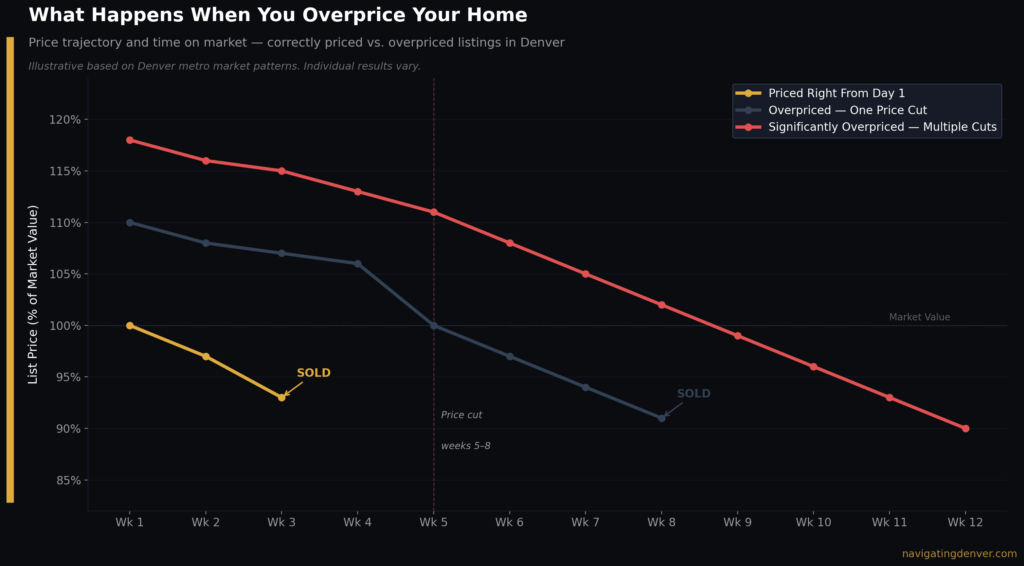
Here’s something most sellers don’t fully appreciate until they’ve lived it: buyers notice everything, and days on market is the number they notice most. In Denver’s current market, where active buyers are watching the MLS daily and alerts fire the moment a new listing hits, a home that sits develops a stigma fast.
When a property appears in a buyer’s search results on day one, it carries full momentum. Every serious buyer who fits the profile is looking at it. Showings stack up. Offers come in. The seller has leverage.
By week three, the calculus is different. Buyers start asking why it hasn’t sold. They assume something is wrong. They come in lower. And the seller, who turned down perfectly good offers early because they were chasing a higher number, is now negotiating from a weakened position.
The market’s first impression of your home is the strongest one it will ever have. Pricing correctly is how you protect it.
What Overpricing Actually Costs You
The logic behind overpricing feels sound on the surface: start high, leave room to negotiate, see what the market brings. In practice, it almost always produces the opposite result.
Consider two scenarios on a home with a true market value of $600,000:
Seller A lists at $600,000. Showings start immediately. Three offers come in during the first weekend. The home sells at $608,000, slightly over asking, in eight days.
Seller B lists at $639,000, reasoning that buyers will negotiate. Showings are slow. After three weeks with no offers, the price drops to $619,000. More time passes. A second reduction to $599,000. By now the home has been on the market 47 days. A buyer submits at $581,000, using the days on market as leverage. Seller B accepts — exhausted, frustrated, and $27,000 behind where Seller A landed.
This scenario plays out constantly in Denver. The price reduction that was supposed to generate activity signals desperation instead. Buyers smell it.
How an Agent Arrives at the Right Number
A professional pricing recommendation isn’t a guess and it isn’t a flattering estimate designed to win your listing. It’s built on a Comparative Market Analysis — a CMA — that looks at what buyers have actually paid for homes like yours in your area, recently.
The comps that matter most:
Sold homes within the last 90 days, within roughly a mile of your property, with similar square footage, bed and bath count, lot size, and condition. Pending sales matter too — they reflect where the market is heading right now, not where it was six months ago.
What gets adjusted for:
No two homes are identical. A CMA accounts for differences between your home and the comparables — a finished basement adds value, a dated kitchen subtracts it, a premium lot with mountain views commands more, a backing-to-a-highway lot commands less. These adjustments are where experience and local knowledge earn their keep.
What doesn’t drive the number:
What you paid for the home. What you need to net to buy your next property. What your neighbor sold for three years ago. What Zillow says. None of these are market data, they’re noise that clouds the analysis and leads sellers to unrealistic starting points.
Pricing for the Market You’re Actually In
The right price isn’t just about comps, it’s about timing. The same home priced identically can produce very different results depending on whether you’re in a seller’s market, a buyer’s market, or somewhere in between.
| Market Condition | Months of Supply | Pricing Strategy |
|---|---|---|
| Strong Seller’s Market | Under 2 months | Price at market value — competition does the rest |
| Balanced Market | 3–5 months | Price precisely at market value; no cushion to negotiate upward |
| Buyer’s Market | 5+ months | Consider pricing slightly below market value to generate urgency |
In Denver’s current market, we’re sitting at roughly 41 days on market across the metro with inventory around 8,200 active listings, conditions that lean balanced to slightly favoring buyers in most price bands. That means precision matters more than it did in 2021, when almost any price would eventually attract an offer. Today, overpriced homes don’t quietly sell in 30 days. They sit.
Understanding which micromarket your specific neighborhood falls into is equally important. Centennial near Cherry Creek schools is performing differently than the downtown Denver condo market. Pricing strategy that works in Arvada may not apply in Littleton. The submarket context is everything.
One Detail Most Sellers Miss: Search Thresholds
Buyers search in price brackets. On every major portal — Zillow, Realtor.com, Redfin — buyers set a maximum price and the search filters everything above it out completely. If your home is priced at $506,000 and a significant pool of buyers has their max set at $500,000, those buyers never see your listing.
This is why pricing at $499,900 vs. $501,000 is not an arbitrary distinction. Price at $499,000 and you miss everyone searching above $500,000 but if you price at $501,000 then you miss everyone searching below $500,000. Pricing at $500,000 gets the most attention and attracts the largest buyer pool.
A well-priced home at a clean threshold number will often out-perform a home priced $10,000 higher — not because buyers are being irrational, but because they simply never saw it.
Pro Tip: If your agent recommends a price lower than you expected, don’t dismiss it before understanding the comps behind the number. The agents who win the listing with the highest price estimate are often the ones who end up asking for reductions 30 days later. A realistic price from day one protects your negotiating position and your timeline.
Pricing Right: What To Do and What To Avoid
✅ Do This
- Request a full CMA from your agent before you set any number — not an estimate, a proper analysis with pulled comps
- Look at pending sales, not just sold data — they reflect today’s buyer sentiment
- Price at or slightly below the top of your relevant search bracket
- Trust the market data over your emotional attachment to the number
- Commit to the price for at least the first 14 days before making any adjustments
❌ Avoid This
- Pricing based on what you paid plus renovations — buyers don’t reimburse sunk costs
- Starting high “just to test” — the cost of that test is your best buyers at peak momentum
- Relying solely on automated estimates like Zestimate — they can’t account for condition, updates, or micro-location factors
- Interviewing agents and choosing the one who gives you the highest number without the data to back it up
- Letting a price reduction become your marketing strategy

The Right Price Is the One That Gets You the Best Outcome
Pricing your home isn’t about finding the highest number someone might conceivably pay. It’s about finding the number that puts maximum competitive pressure on the right buyers at the right moment — generating urgency, offers, and ideally multiple parties competing for what you’re selling.
In Denver’s 2026 market, that number is almost always at or very close to market value. Not above it, hoping for a windfall. Not below it as a giveaway. Right at it, with a sharp presentation and a strong marketing push behind it from day one.
If you’re thinking about selling and want to understand what your home is actually worth in the current market — not what an algorithm says, not what the neighbor sold for two years ago, but what a qualified buyer would pay today — that’s a conversation worth having before you make any decisions. Reach out and I’ll put together a full pricing analysis at no cost and no obligation.
Have Questions About This Topic?
Every situation is different. Let’s talk about how this applies to your specific goals in the Denver market. No pressure, no obligation — just straight answers.